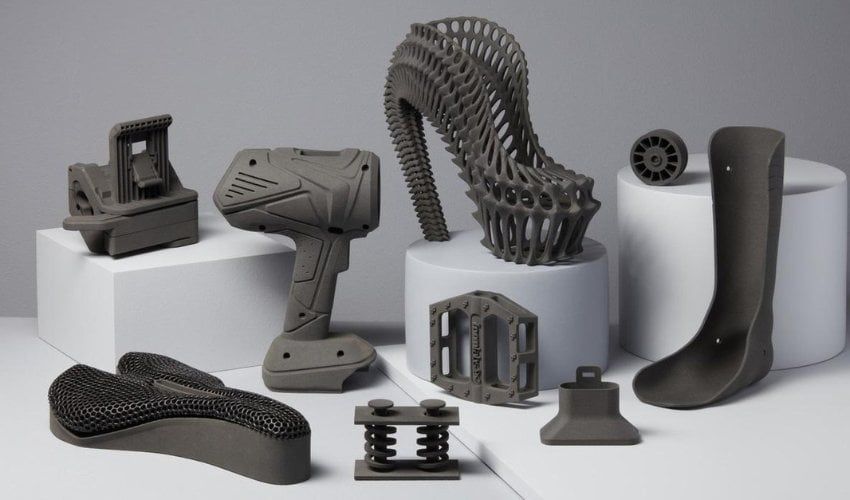
Digital to physical: AI concepts, materials, and fabrication mindset
Digital fabrication exploration: AI concepts to printed objects, material tradeoffs, and how making builds stronger design leadership confidence.
I have spent a lot of time at a desktop 3D printer—well over two hundred hours of printing, iterating, and learning what fails when plastic meets physics. Digital fabrication, for me, is not a certificate on the wall; it is an ongoing practice of closing the loop between digital intent and physical consequence. I am not positioning myself as someone who has run professional fabrication prep for manufacturing at scale. What I am doing is deliberately moving from rough concept and AI-assisted exploration to a part I can hold, stress, and revise. That bridge—sketch to CAD to slice to print—is where my practice is growing. This post is about why that matters for how I think as a designer and a leader: materials as tradeoffs, not trivia; the mental shift that comes from making; and the confidence that spills beyond the screen.
Digital fabrication exploration: from AI concept to physical object
The thread I care about is sequential and inseparable: idea → visualization → constraint-aware form → something real.
Sketching and conceptualizing with AI. Generative tools are useful here in the same way thumbnails are—not as the final artifact, but as a way to branch quickly through silhouettes, proportions, and “what if we solved it this way?” moments. The point is not to outsource judgment. It is to externalize possibilities fast enough that you can compare them, then commit to a direction you will own in CAD and at the printer. The AI-assisted phase helps me name what I am trying to build before I invest hours in plastic.
CAD as translation, not decoration. Once a direction exists, the work becomes explicit: dimensions, mates, clearances, orientation for printing. That step forces honesty. A concept that only lives in a mood board can stay ambiguous. A model that has to slice and survive contact with a bed cannot. From Figma to filament: why I 3D print as a product designer goes deeper on how that discipline connects to product work; here, the emphasis is on conceptualizing the physical object—not as fantasy, but as something that could exist.
The print as a truth test. The printer does not care about your narrative. It cares about layer adhesion, overhangs, thermal behavior, and whether you left enough clearance between two sliding parts. When the first layer warps or a snap fit cracks, the feedback is immediate and unsentimental. That is the connection between digital and physical I am chasing: the same idea, tested against matter.
The loop I run (and rerun). Model in CAD, slice for the machine, print, measure, break what deserves breaking, adjust parameters or geometry, print again. The wall-clock cost is higher than pushing pixels, which is exactly why it is valuable: you cannot hide behind a beautiful render. When something fails, the postmortem is specific—this orientation weakened layers, this clearance assumed too little variation, this corner concentrated stress. That habit of naming the failure mode before the next attempt is the same habit I want in design reviews and roadmap conversations: specificity beats vibes.
Parametric thinking without pretending I have solved manufacturing. In CAD, I still think in relationships—base dimensions, derived clearances, a hole that tracks a peg diameter—because that is how you keep a family of parts coherent when one input changes. That maps cleanly to design systems work (tokens, dependencies, propagation). I am not claiming factory-floor DFM expertise; I am saying the dependency mindset crosses domains, and fabrication practice makes the graph tangible.
Materials: benefits, drawbacks, and choosing when to use what
Material choice is not a label you pick once—it is a bundle of behaviors. Desktop FDM printing made that legible for me in a way specs alone never did.
PLA is dimensionally cooperative for many geometries and prints reliably in open air. It is also brittle under impact compared with tougher options—fine for jigs and decorative shells, questionable for parts that will see drops or repeated flex.
PETG trades some rigidity for toughness and layer adhesion that forgives more real-world abuse. It strings more, likes different bed and cooling behavior, and still will not save a bad load path.
ABS asks for thermal management (enclosure, ventilation discipline) in exchange for heat resistance and toughness in certain applications. It is a reminder that “stronger material” is never free—it comes with process debt.
TPU is the flexibility lesson: vibration damping, living hinges, compliant clips—at the cost of precision and speed.
I am not cataloging this to sound like a materials handbook. I am cataloging it because understanding physical complications—what each choice optimizes and what it punishes—is the same muscle as weighing frameworks, tech stacks, or org processes: there is no perfect option, only fit for the scenario. The more honestly you map tradeoffs, the fewer surprises late in the process.
What mentally enables building physical products?
There is a permission structure people rarely name. Digital design careers reward fluency in abstraction—flows, systems, narratives. Physical making adds a different requirement: you must tolerate being wrong in a medium that wastes time and material.
That tolerance changes you. You stop treating the first model as precious. You expect revision. You look for the failure mode early because the machine will find it anyway. In leadership terms, that is uncomfortably close to running pilots, shipping MVPs, and admitting when a program needs a pivot—iteration without ego.
Another shift is spatial accountability. On a screen, you can imply depth. In CAD for printing, implied depth becomes wall thickness, unsupported spans, and whether a bracket can actually carry load. You start asking “where does the stress go?” before you ask “does it look right?” That reordering—constraints before polish—is useful everywhere, including when you are aligning stakeholders who want beauty before feasibility.
You become a bigger problem solver—not only on the screen
Digital fluency lets you optimize what people see and tap. Physical practice forces you to optimize what survives contact. The problems are related but not identical:
- A layout can be “correct” in Figma and wrong on a low-end device; a part can be “correct” in CAD and wrong once the first layer cools.
- A flow can fail because copy was ambiguous; an enclosure can fail because tolerance was under-specified by two tenths of a millimeter.
When you practice both, you stop believing that digital correctness equals reality. You look for the gap—rendering context, manufacturing variation, human error—and you design for it. That is not pessimism; it is systems thinking with skin in the game.
The same instinct shows up in softer work: a narrative that sounds airtight in a deck but collapses in a sales call, or a process that works for one team size but not another. Physical practice does not automatically make you brilliant at org design—but it trains you to distrust the first perfect-seeming answer and to look for where reality will disagree with the model.
How does confidence in making translate to design leadership?
Confidence here is not swagger. It is the quiet knowledge that you have repeatedly taken something from “idea” to “held object,” debugged failure, and improved the next version. That cycle is transferable:
- Stakeholder conversations. You speak about tradeoffs with concrete examples—time, material, risk—because you have paid those costs personally.
- Cross-functional credibility. Teams feel when a leader understands constraints beyond slides. You do not have to fake manufacturing expertise; you have to show respect for constraints and a track record of learning under them.
- Calm under ambiguity. Making teaches that the first answer is rarely the last. That steadiness helps when product direction is contested or timelines compress.
You are not solving only digital problems anymore—you are rehearsing the same problem-solving muscle against what you can see, weigh, and break. The overlap is the point.
Where this sits in a broader maker practice
None of this replaces industrial DFM for production at scale. It informs how I think about fidelity, iteration, and honesty in the work. For the wider picture—CAD, the home lab, and how these threads connect—see the designer’s maker lab: CAD, 3D printing, and woodworking. For systems thinking that extends beyond software into how you run a life, engineering concepts for everyday life: redundancy, MVPs, and kanban pairs well with the mindset above.
What am I still learning?
Industrial fabrication—tooling, tolerances at volume, supplier workflows—is not what I am claiming here. My exploration is desktop-scale, high-feedback, personal accountability. The through-line is unchanged: digital to physical literacy makes me a more grounded designer and a more credible leader when tradeoffs get real.
Key Takeaways
- Digital–physical is one arc: AI-assisted exploration helps branch concepts; CAD and printing force those concepts into accountable form.
- Materials are decisions: each filament family trades printability, toughness, heat resistance, and precision—choosing is practice in tradeoff thinking, not memorization.
- Making builds mental habits: iteration without ego, constraint-first thinking, and early failure analysis apply to product, org, and leadership challenges—not only to plastic.
- Problem-solving spans media: rigor on screen plus rigor in matter reduces the gap between “designed” and “true under stress.”
- Confidence transfers: credibility with stakeholders and teams grows when you have repeatedly shipped ideas into the physical world and learned from what broke.